
It’s Not Raining Rain To Me; It’s Raining Daffodils
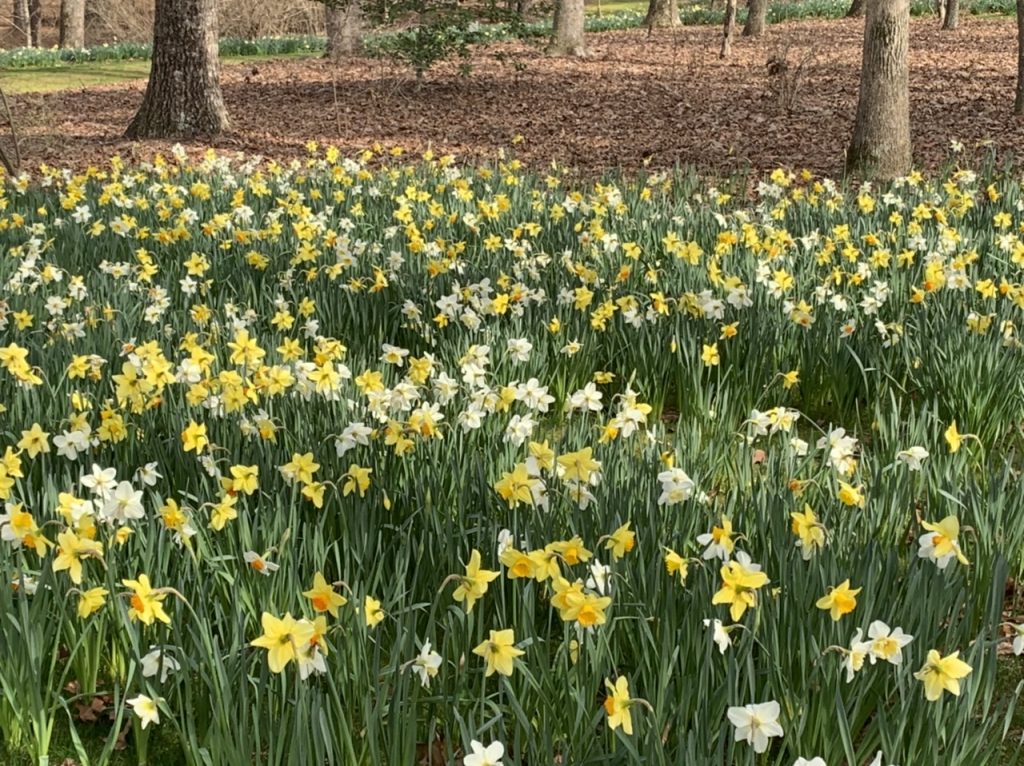
My daffodils bloomed early this year, in the middle of a dreary and wet February. Their sunny yellow color seemed misplaced on the gray, misty day when they first appeared. They were, of course, a welcome sight because daffodils mean spring is near. Where flowers bloom, so does hope.
I’ve never given daffodilsmuch thought before, just accepted their appearance each year as a symbol ofspring and Easter. But my little bunches of daffodils stood out so oddly thisyear they demanded I stop and consider them.
The botanic name for daffodils is narcissus and their petals can be white, yellow, or light orange. Daffodils were brought to Britain by the Romans who incorrectly thought the sap from daffodils had healing powers.
Folklore attaches luck to thespring flower. It was once a common belief that fortune would smile on thosewho avoided stepping on daffodils. In the British Isles, the first person inthe neighborhood to spot the first daffodil of spring would see more gold thansilver coming his way.
OtherFun Beliefs
Togive someone daffodils is to wish them luck. BUT, give them an entire bunchbecause a single flower can bring disaster and harm.
Displayingfresh daffodils in your house will attract an abundance of good things.
If you need love, wearing a daffodil close to the heart is said to attract love.
I mentioned I associated daffodils with Lent because I often seethem pictured with the Cross during this season. Interestingly, in England, daffodilsare known as the “Lent Lily.”
While there is a legend circulating incyberspace that daffodils bloomed when Christ rose from the tomb, thereis no mention of this particular flower in the Bible. I think spring flowers ingeneral serve as reminders of the resurrection.
As well as many other things.
I love this Martin Luther quote:
“God writes the Gospel not in the Bible alone, but also on trees, and in the flowers and clouds and stars.”
God uses flowers and all of nature to teach us Biblical truths. But sometimes maybe He simply wants us to pause and appreciate the beauty of His world.
God uses flowers and all of nature to teach us Biblical truths. But sometimes maybe He simply wants us to pause and appreciate the beauty of His world. Share on X
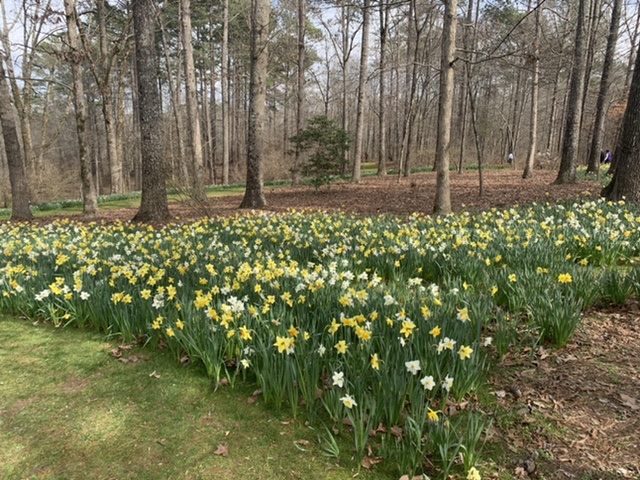
With this in mind, we took a leisurely drive over the mountain on Sunday afternoon to see the daffodils blooming at Gibbs Gardens. Located in Ball Ground, Georgia, the garden is home to 20.000,000+ daffodil bulbs during March and April. Not all of them bloom at the same time, but the number in bloom was staggering and a sight to behold. Amid all those daffodils, I saw our Creator and drew closer Him.
After a lovely day, I awoke to more rain. At first, I was annoyed. Then I recalled a poem by Robert Loveman—a writer I profiled six years ago. The title of this post is taken from his poem, “Rain Song.” Here are the first two stanzas:
It is not raining rain to me,
It’s raining daffodils;
In every dimpled drop I see,
Wild flowers on the hills.
The clouds of gray engulf the day,
And overwhelm the town;
It is not raining rain to me,
It’s raining roses down.


Comments